Introduction
The first section of this essay will explore how ontological shifts – states of spiritual awakening1 and revelatory events2 - can unveil the unexpected structure of ordinary existence3. Through ruptures of ordinary perception and cognition, we might see that the ordinary reality that conventionally appears as solid and properly grounded has dimensions that we were previously unaware of. We will use Istvan Banyai’s (1949-2022) illustrations from his classic work Zoom (1995)4 in order to present a visual analogy of what ontological shifts – boundary breaking events – entail for the underlying framework we hold about reality. I wish to present these shifts or transitions along with the idea of ontological relativity5: once a violation or rupture of the habitual order of the world takes place, it becomes impossible to sustain and live within the previous frame of reference, and all of them become relative and contingent. If this event takes place repeatedly, at some point we might ask the profound question: is there any fundamental basis for reality? Is reality, deep down, devoid of any basic metaphysical ground? Is reality intrinsic of any foundational framework, and therefore empty?
The second section of this essay will elaborate how the theme of ontological shifts is connected to artistic processes and creations. I will the explore the work of the mystic painter Frederick Franck6, who argues that underlying visionary art lies a state of naked perception in which the true essence of both the subject and the object is actually perceived. I will mention the case of the radiance of the underlying buddha-nature in Dzogchen7, and from Franck’s reflections I will dovetail to the specific case of the Ensō image within the Zen-Buddhist tradition8, arguing that such artistic creations require a shift of perception and being – that I have termed an ontological shift – what in Zen is termed satori and awakening9.
Ontological Shifts and Boundary-Breaking Events
By ontological shift I mean an event that takes place in the middle ground of two apparently distinct orders of reality. The first is the one we are habitually used to: the ordinary world we spend most of our time in. The second is the flip side of this world, at the interstices of reality. The ontological shift is the crossing of the boundary. It allows this world to be seen from the other side, after the suspension of the ordinary involvement we have with the world. This implies, of course, that reality has sides, or aspects which at times can be accessible or not to consciousness. It may be the case that reality is not fundamentally defined from standing within it, but only outside of its ordinary purview – beyond it. What lies at the other side is in a sense not included in ordinary reality, but designates the value and meaning of everything that is here, within the ordinary construct of spacetime living. The event that breaks the rule actually reveal its significance and purpose. An ontological shift attempts to straddle both orders: the ordinary and the extraordinary, the sacred and the profane, the natural and the supernatural, the unreal and the real. This ontological bridging has a significant cost, however. It becomes impossible to live wholly enclosed in either order – exclusively human or angelic, bound to heaven or to earth, enjoined to facticity and practicality of life and yet intermittently open to hierophanies that reveal the very basis of the ordinary world.
Consider Istvan Banyai’s famous Zoom (1995) series of illustrations. In each picture we see a set of structured elements that we may reasonably call a world. There are ordinary objects, people, events take place – they are recognizable human scenes that provide no ulterior meaning to what takes place in them. As we switch from one scene to another, an ontological shift takes place: the basic framework of meaning one utilizes to grasp the scene is completely shattered, although none of the objects or aspects of the scene is changed. All is the same yet all is completely other. Every transition dissipates the reality quale of what we were acknowledging: a farm scene consisting of multiple houses seen from an aerial vantage point (fig. 1) remains as such, but now that a hand is seen over it (fig. 2) it becomes unreal, fictional, demoted from its original ontological status. Nonetheless, the sensual elements are unchanged. One could equally describe the before and after scene using the same pictorial descriptors. However, its meaning is radically transformed. I propose that ontological shifts produce these peculiar transformations: they reframe the meaning of everything we knew about the world, although the set of external relations that define our world is unchanged. Ordinary reality still obtains, although the ordinary…is no longer.
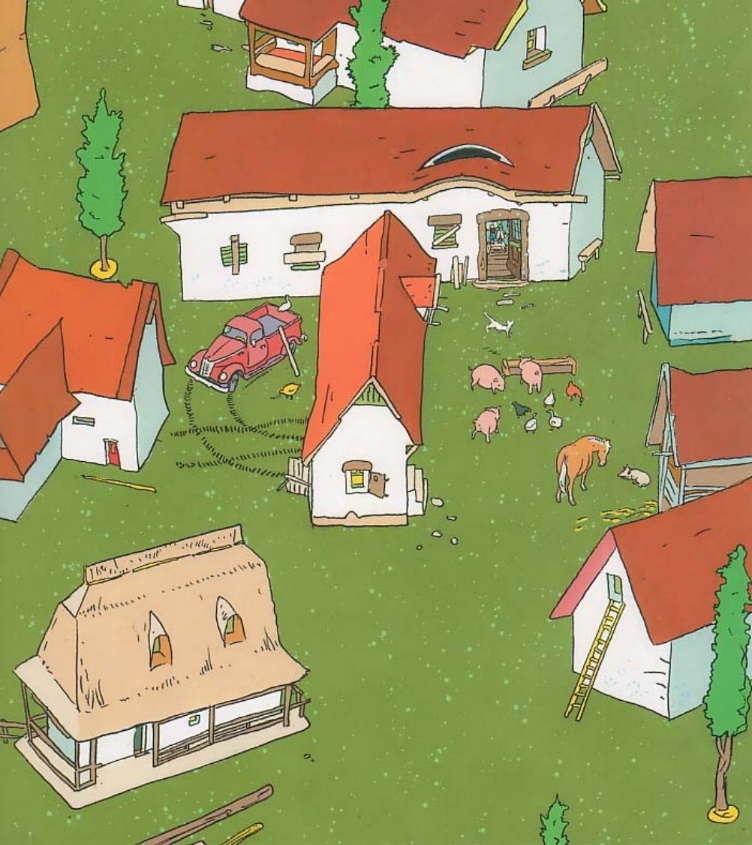
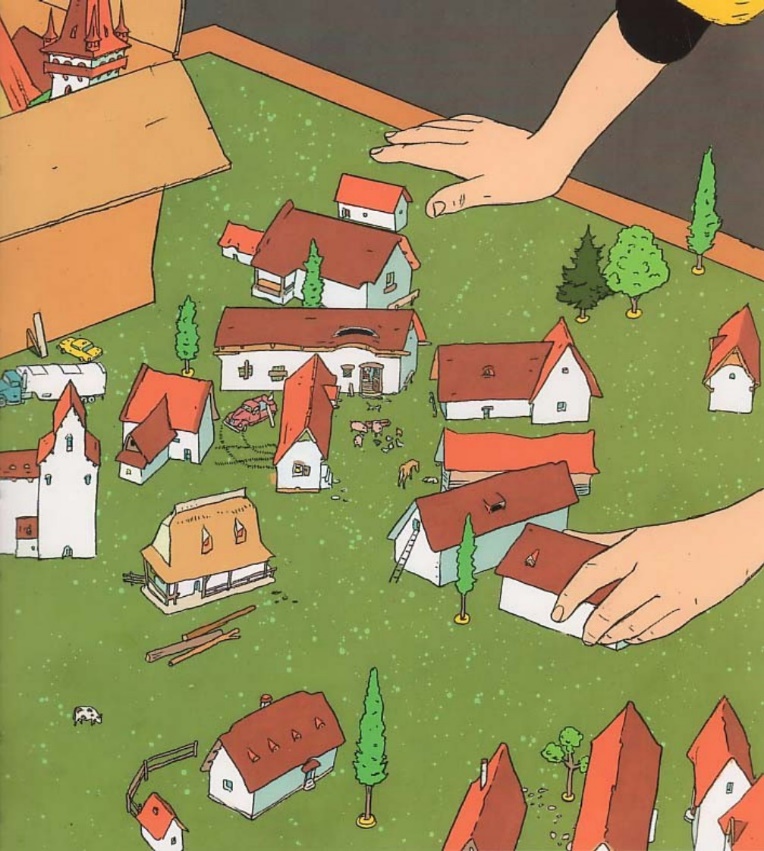
Figs 1 and 2 – Extracted from Zooom (1995)
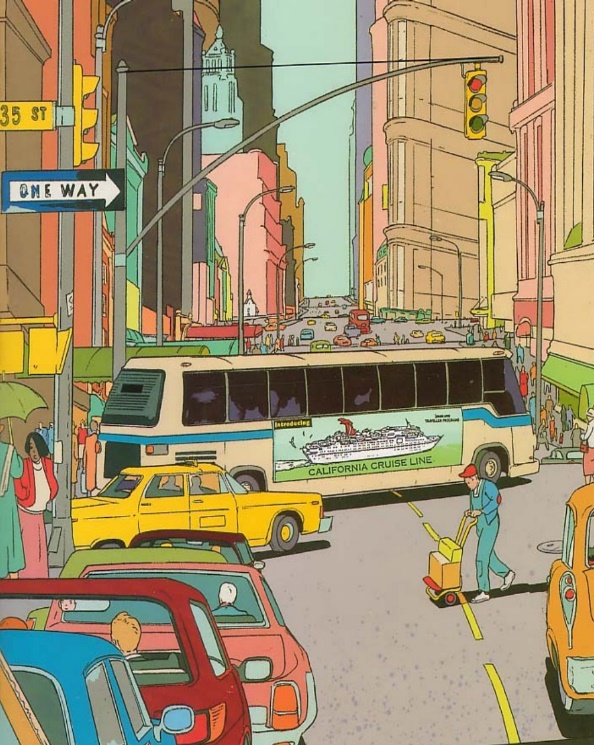
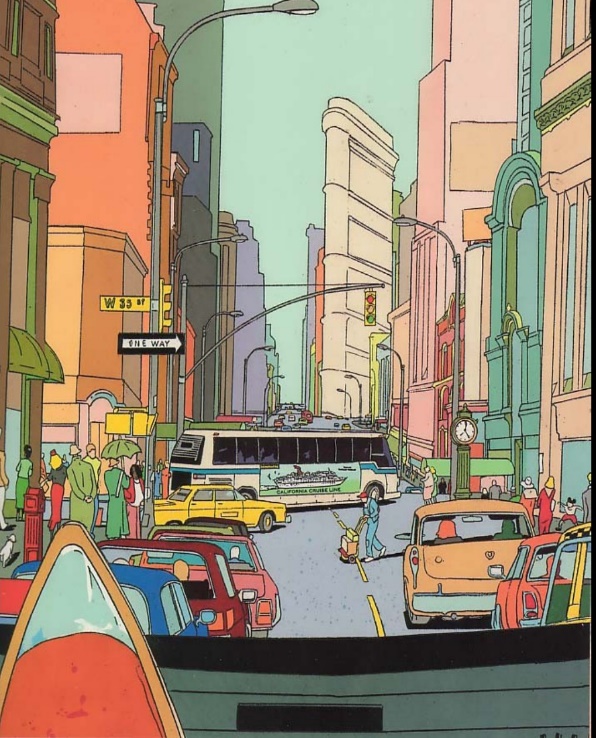
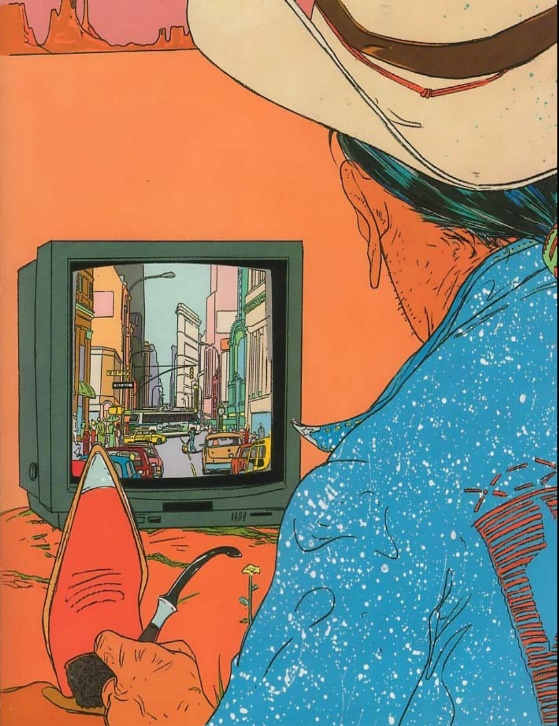
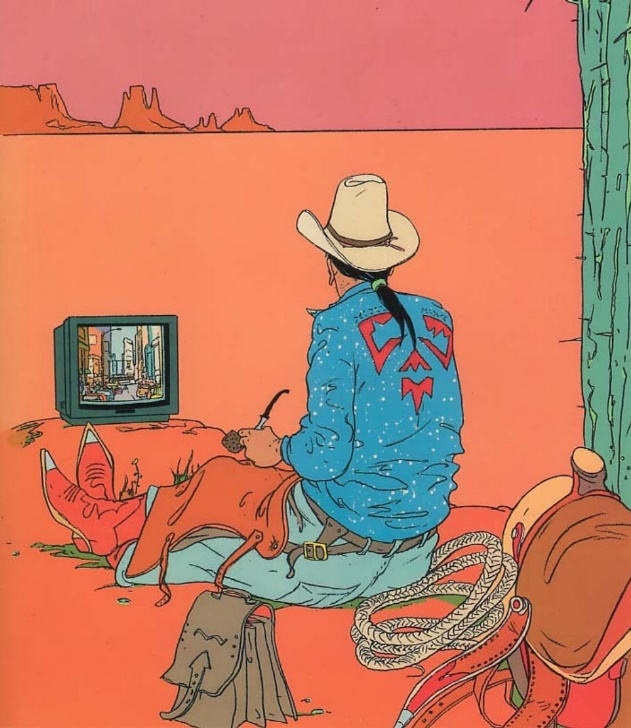
Figs 3 to 6 – Extracted from Zoom (1995)
Each jump or transition brings forth a complete contextual transcendence. The overall framework is lost, and after a series of such shifts we may come to ask: is there a final or ultimate context from which we can judge or evaluate anything that appears in the purview of consciousness? Is any final theory of reality, final? The very fact that such a transcendence is possible for one picture, in our case, for one world picture, entails that all others may be destined to a similar fate. I argue that this ultimately produces a perspective of no perspective, a reality based on a contextless context: nothing in itself is real, but only relatively to the framework at hand. There is no final position that can give us rest in terms of the real: reality is, in a significant sense, groundless, or utilizing the technical Buddhist term, empty.
From Ontological Shifts towards Ontological Relativity
The Zoom series provides us with the idea of ontological relativity. The reality posit of any given phenomenal field is determined by the observer’s frame of reference of the field, and yet the observer is implied in every field. If we term the observer of every field as consciousness, we would say that it is an invariant fact present to every field, although with little to no essential attributes assigned to it. Consciousness could also be considered as the property or quality that makes an objective field recognize itself as such, and thus opens it to this fact. The recognition of existence would not be possible without it. That we acknowledge consciousness or mind, that it is possible to bracket or suspend our natural involvement with any field or world picture, simply means that this standing outside of it is possible, although nothing can be said or attributed to this act of ontological transcendence. Every moving away from one Zoom picture to another consists in a loss of a complete framework of meaning – might not this loss be the main gnostic event? Take away the whole castle of assumptions about reality, the metaphysical scaffolding that made reality possible in the first place, and then, what is left? This line of thought would argue that nothing is left, and that is precisely the point. Once again, the internal meaning of a given phenomenal field remains unchanged, but this outside jump completely ressignifies its reality quale, as we leave aside the implied context, its standard frame of reference of valuation.
There is no permanent underlying background, context, ground or basis, and so, every reality or world is observer – consciousness dependent. Nonetheless, what consciousness is, or what we can say about it, has to be dependent on the world it lives in, or the reality it builds in order to recognize itself. Would it be possible to be otherwise? In this regard, we must say that if enlightenment has any import, we have to see it as a radical ontological and mereological transformation – a delimited section of the whole-total system of consciousness recognizing itself within and as the whole. It is a rupture of the natural involvement with the world. For the duration of a hyperdimensional glimpse, reality becomes unrooted from its ordinary ground and consciousness or mind emerges as its unknowable source. There is nowhere to go or door to open that will furnish an ultimate sense of existential stability. Could this be the fundamental sense of what Buddhahood entails? The ultimate transcendence of worldliness itself? The part – the person living their life – is for a time unmoored from usual ontological categories and experiences a breakthrough to the other side? The veil is parted, the curtain drops, but no man is found. The dream is acknowledged as such, but of the dreamer – what can be said about it, beyond the fact that the dream presupposes it? Where could we find it, when whereness itself is no longer foundational?
But what exactly does it entail, to be in the world but not of the world? I mentioned the suspension of the natural involvement with ordinary dimensionality and the usual spacetime framework we live in as a necessary precondition for a shift of this kind to take place. This does not mean, of course, that one is no longer physically responsive to the world or that awareness of ordinary space and temporal boundaries is lost. It does imply, however, that something else, a new dimension if you will, has been superadded life. Could we term this new dimension consciousness or mind? If we do include mind or consciousness in our world picture, it will become impossible to fully characterize any given state of reality without mentioning its subjective - or mental - dimensions. Mere locality and usual temporality won’t be sufficient to properly account for existence. This implies that mind or consciousness is not taken to be identical to a physical construct - a brain - but it is indeed something of another order, an additional dimension in the structure of the world.
That it becomes possible in these shift for the mind to survey spacetime from above, so to speak, from beyond itself, is a clue that this theoretical move might be warranted. In the same way that an additional dimension takes a previous one and supersedes it - a 2D plane from a 1D line, a 3D volume from a 2D plane - consciousness appears to do the same in regards to spacetime. When fully acknowledged, such as in states of high transcendence such as the Buddhist jhanas or yogic samadhis, consciousness is finally acknowledged in its own level, or as its own dimension. No longer simply derivative, a byproduct from the usual levels or dimensions of the world - the 4dimensional spacetime we habitually live in - but as something wholly new and other. The usual spacetime dimensions that define our experience of the world still obtain - we are still in the world - but consciousness is no longer fully delimited by it, no longer of it.
If this interpretation of the transcendence of the world, of an ontological shift is correct, it would imply that a subjective transformation - a shift in consciousness - is not simply in our heads. If a state or feeling of immortality is described, for instance, it might not merely be a subjective coloration without proper ontological foundations, but might actually express that one has become rooted in a dimension - or might they be plural? - that is as real as the spacetime dimension we utilize to locate a rock or a far away quasar. The inner world might indeed be a world after all. It might possess a structure that is as solid as the material reality we have become so accustomed to relating to.
If the multidimensionality of our being is taken not as a metaphor but as an actuality, how would this change our understanding of ourselves? It would imply that the visible reality in which we live in only incompletely describes and explains what and who we are. There is more than meets the eye, and in fact, that might mean that the eye itself is the unaccounted factor. From this premise we would discover or uncover that our narrative about our lives - both individually and collectively - has proceeded from a preliminary foundation that has excluded possibly the most important dimensions of what we are. This is the out of the world part of the story. The disruptions of the ordinary framework, whether through trauma, spontaneous anomalies or the bare recognition of the transiency of life might effect or trigger this shift, this dimensional mutation.
The complex and difficult experience of this existential mutation is probably one of the major sources of pathologization that surrounds spontaneous ontological shifts that are unsupported by traditional structures of development. It is certainly possible, in fact mostly probable, that this emergence into a novel domain of experience is not lightly felt by the conventional cognitive structures most of us live and operate upon. The destabilization it may produce may be one of the major reasons for the instability of subjects that experience and their incapacity to translate and to operate on our conventional layers simultaneously — what is often experienced and diagnosis as psychosis or a spiritual emergence.
Nonetheless, it is important to differentiate the experience of psychosis from that of mystics, even though their phenomenology overlaps in highly significant ways. It might be argued, however, that the mystics comprise the exception and not the rule, in the vast array that constitute the phenomenology of ontological shifts. From an evolutionary standpoint, to operate simultaneously in two incommensurate domains of being is a significant feat and acquisition. It is to be expected that there is a gradation of states that takes us from subjectivities that are most adequately involved in these two domains, and others that cannot produce the necessary bridge. However, that should not negate their epistemic validity; in fact, the troubles that the psychotic and others who experience disorders of the self-system go through might shed a great deal of light in what actually happens spontaneously and in a sub-liminal threshold in the mind of a full-fledged mystic.
If is possible for an individual mind to realize itself in an ontological mode not available to ordinary cognition, then the claim of exclusive existential validity of the normal way of functioning is untenable. In fact, historical evidence is overwhelmingly supportive of the thesis that most if not all of the contributions in religion, philosophy, art and science came from states of being that surpass the boundaries of the conventional mind. Yet, our current psychological, philosophical and psychiatric outlook cannot accommodate these states and mostly disqualifies them as viable objects of study or goals in the formalized process of psychological development.
It is entirely reasonable, therefore, that we are currently collectively operating in a low point in the spectrum of mentality simply by not recognizing the validity of other states of being, declaring their emergence as pathological or not having a framework that might serve as explanatory for individuals that experience them. The most basic answers we have about life depend on innumerable unquestioned metaphysical - extraphysical - premises. This is the elementary framework we live in. As an example, a significant assumption in our age has been the localization of our mental space, of the imagination, into a well-defined - albeit mysterious - complex object, our brains. This is, of course, the reduction of the subjective structure of the world into the outer. It consists in a dimensional reduction. We are required to become or assent to less than we are in order to effect it. The imagination - or the mind - loses ontological value and is no longer treated as a portal or instrument that allows us to peer into unexpected realities or worlds. It is important to note that this is nothing more than an hermeneutical overlay; the datum the imagination provides has kept continuously active throughout the ages, and has informed and been the basis for possibly all of the religious systems of the world. This is a significant claim. Nonetheless, if the imagination is freed from its conventional shackles, from its imposed limitations within the boundaries of local and delimited space, we might regain the capacity to actually understand where the vast mythological and cosmogonical dramas of the world actually emerged from. From our heads, yes, but not only from them.
Additionally, ontological shifting leads to radically novel experiences and understandings of being, the other and reality. Therefore, different nosological systems are needed, in which the basic presuppositions that underlie contemporary psychiatry do not necessarily hold. In order to integrate novel ontological outlooks into the intersubjective plane a non-pathological and non-normative understanding of being and mind is needed. It does not ignore pathology as a state of suffering and instability, however, it acknowledges that it is precisely the pathological interpretative mode that tends to foster and exacerbate ontic problems.
Each ontological viewpoint possesses its own underlying structure that can be correlated with other viewpoints, the common denominator between being itself, being as a direct, immediate, simple and universal affirmation of what is, beyond any epistemological investigations that may unfold, describe and interpret being. Ontologies, different as they may be one from the other, may become functionally adaptive in regards to the common intersubjective plane and in regards to one another to the extent that they are capable of translating their own internal syntax and semantics towards others; they therefore enlarge and enrich the field of Being itself.
The question of Being brings us back to the significance of Art in all this. If the imagination is not simply fantasy, not merely the fantastical expression of feelings and invented worlds, but actually an eye, then what and who is the artist? One possible formulation based on our preceding discussion: a transliminal being straddling worlds. If the ontological development of the artist includes a dimensional birth, a radical mutation, it would explain the untold existential difficulties not only of artists but of those that live in the boundary of the world and often step outside its margins. This peering outside of the structure is disruptive for the transliminal individual but also for the non-transliminal ones. The meaning and value of reality is stake. Everything we do depends on the world being assumed as real as it is. This is ordinary realism. Only in exceptional instances can the world’s reality be suspended or violated. Is this clash or tension a function of our modern outlook that excludes wholesale existential anomalies and disturbances of every kind? Would a more integrative or holistic approach allow us to live with the extraordinary, the supernatural or the impossible side by side?
One thing is certainly clear: a fuller account of reality would be vastly different from what we have today. What would need to change in our modern world for us to be able to live collectively within a reality that integrates all kinds of psi-events, anomalous occurrences and contacts with entities of every sort? Are we ready for this? We have to, for many are already living and experiencing it. We have excluded important elements of reality’s story at our peril. By ignoring the transliminal we have once more reduced the dimensionality of our world and consequently reduced ourselves.
Visionary Art and Enlightened Seeing
Art that turns out to be more than a sublime expression of this world’s categories opens us up towards the unseen vistas or dimensions of reality. There is nothing new here. In different language, most religious art acknowledged its origin based on higher or transcendent realities. This is only a shock for the contemporary secular mind. Without the activity of art the conscious and unconscious dimensions of the world would remain dissociated, apart. And it is this split that ails us in most modern societies. A graphic example: the spread of graffiti in major metropolises and urban centers. From one side this takes place as an expression of rebellion, tribalism and an attempt to delegitimize formal structures of convention, power and tradition. It expresses symbolic truths that cannot be acknowledged otherwise. Interestingly, when proper space is given in major cities for graffiti artists to express themselves, to have a voice in the shaping of urban spaces, high creative art emerges that supplants the need more mere vandalism. A bridge has been established between the visible and the invisible, a the barrier of repression has been lowered or, at times, dissolved completely.
As artist and self-professed mystic Frederick Franck has stated, the foundation of artistic practice is enlightened seeing.10 What does this mean exactly and how does that connect us to our discussion regarding ontological shifts, transformation of being? As Franck points out in his beautiful works The Awakened Eye and The Zen of Seeing: Seeing/Drawing as Meditation, true seeing is not effected by the physical eyes. Not only by or through them, that is. Genuine seeing concerns the unified inner eye, the Eye of the Buddha, of awakened consciousness recognizing its unity and inseparability with the contemplated object or worldly scene. In this state, having shifted from the ordinary framework of perception and cognition towards one in which no veil of separate selfhood remains, the artist - he or she that has experienced the shift - moves the drawing pen or the painting brush and expresses the very being of that he or she is attuned to, a flower, a naked model, an awe inducing scene. It is a kind of non-separate doing, a enlightened activity that breaks the boundary of ordinary dasein, of being in the world as an atomized center of consciousness distinct from the surrounding world.
As we mentioned previously, regarding the suspension of the ordinary involvement with the world in the Zoom series, this disruption is a deautomatization11, a dealienation12 from habitual modes of seeing and being in which consciousness is either half-asleep or totally immersed in its unconscious productions. As Betty Edwards13 has noted in Drawing with the Right-Side of the Brain, the cognitive schemas we blindly superimpose on the world through learned examples, mimicry and habituation impede us from seeing what is actually there. I do not see a hand in its direct sensuality, with is contrast between dark and light areas, its subtle boundaries merging with the supporting table, but only my internalized schema concerning how a hand is supposed to look. The hand’s inner life does not strike me, I do not actually feel it; I experience it only as secondary to my apprehension of it. It hasn’t become possible for me to leave my self-centered way of perception and cognition in order to fully grasp it, to leave myself in order to grasp it from within. I see it as a shadow in the cave14, as a simulacrum that I have come to name, the world. Thus I do not draw it from true seeing, from a shift of perception in which it becomes recognized in its full directness, but from a secondary mode of perception that is denatured, devoid of directness, actuality and awareness. If we amplify and generalize this example to our general apprehension of the world, I believe we can come to terms with how we usually do not see the world and ourselves, or rather, experience them through the multiplicity of filters that defined an unaware or unenlightened way of being in the world. It is this secondary substitute world, this overlay that removes awareness from the actual experience of living that this kind of shift aims to transport us from.
This transcendence or rupture of this secondary overlay has powerful implications for our experience not only in aesthetic modes but also, in relational terms. If we are living mostly in unaware states of being and cognition, enveloped by our continually self-elaborated private worlds, our capacity for actual relating, for meeting one another in their own terms, will be greatly diminished. It becomes impossible to actually listen without the filter, to actually grasp one another without imposing an immediate reaction that evaluates, grasps and and filters what was heard or perceived in terms of our own pre-established categories, biases and habitual modes of perception. This is unenlightened seeing, being and living. In this ontological mode, we live semi-solipsistically, only occasionally experiencing breaks in the all-consuming stream of unaware consciousness that so throughly defines our modern experience.
We mentioned that when this unenlightened mode of seeing is transcended an inner eye, that Franck has identified with the Buddha Eye, sees the world. The ontological shift that ruptures the structure of ordinary perception and cognition brings forth a radically new mode of apperception of reality. Without the self-centered overlay filtering every perception and cognition, every phenomena can be grasped in an unspeakable - because it is pre and post linguistic - quality that can be termed suchness. As sociologist Peter Berger has - following insights of Freud and others - convincingly shown, the world needs to be built and sustained as a credible - a plausible - independent and objective structure in order for human beings to live and face life. This world-building activity is usually hidden from us, and we that emerged from nature come to see the symbolic and imaginary crafted worlds as possessing reality, whereas in truth, they require human collective assent in order to be experienced and lived as real. They are ontologically contingent. This seeing through the fictional nature of the world Berger termed dealienation, and aligned it with the world-transcending insights of mystical literature, in that mystical claims produce the seeing through the veil of maya in the same sense15. I believe Berger is correct in his assertion and that the shifts of being and cognition we have been discussing is exactly what he terms dealienation, in an expanded sense. I would also argue, following Franck’s transreligious mystical vision, that the novel mode of seeing that takes place after the fictional world we have superimposed is pierced can be properly identified with mystical enlightened perception, or the Buddha Eye.
This is, of course, William Blake’s cleansing of the doors of perception.16 It is the innocent seeing that grasps the world afresh, as if one had never been introduced into the imaginary world that Berger considers as the first act of alienation. That this seeing implies an unified inner eye, a non-dual vision in which a transcendent awareness - either the Atman, Christ Consciousness or the Buddha Eye - sees the world - this appears to be the point that requires further investigation. It could be argued that this is merely an unfiltered kind of perception, in which conventional modes of seeing are suspended, but that no metaphysical implications follow. I would see more clearly, but I, as a separate subjective identity, would remain intact. Nonetheless, in Blake’s or Franck’s vision, the transformed unified vision implicates both the object and the subject in one single integrated perceptive act. I can see the hand afresh, in its direct suchness, not simply because the object is now more clearly sensed and grasped, but because a corresponding subjective transformation has emptied consciousness from a double veil that concerns both the objective and subjective worlds. I can see the hand or the world as it is only when I am no longer there as an ontic intermediary. In my disappearance, the underlying reality of what I am - the Buddha Eye or the Atman - can truly perceive itself without this primary ontological boundary. The claim is that this kind of ontological shift, this ontological transcendence of the subject-object split, recognized by Goethe as well17, is at the core of aesthetic perception; that being and seeing can be experienced as single, unified and transformed whole.
In Dzogchen, such seeing is recognized as a manifestation of the underlying radiance of the the buddha-nature. In deluded modes of seeing, what we have termed unenlightened, automatized and alienated seeing, phenomena are not considered from the root of their true significance and meaning - the underlying Mind that manifested them. Only the superimposition or overlay exists, albeit, at times, glimpses and ruptures can take place and unveil what was latent and unrecognized for most of the time. In this view, beauty is experienced in a way close to Plotinus’ account in the Enneads: as a translucency of the One shinning within and as all things. This translucency of the One, here articulated as the intrinsic radiance of the Mind18, is the proper unveiling of what the world truly is, when experienced from this fundamental ground. To put it in poetic terms: how would the world be experienced if we came to experience our disappearance at death and merely the underlying consciousness substrate remained? How is reality or the world experienced thus?
Art as a spontaneous manifestation of the Buddha-Nature: The case of the Ensō
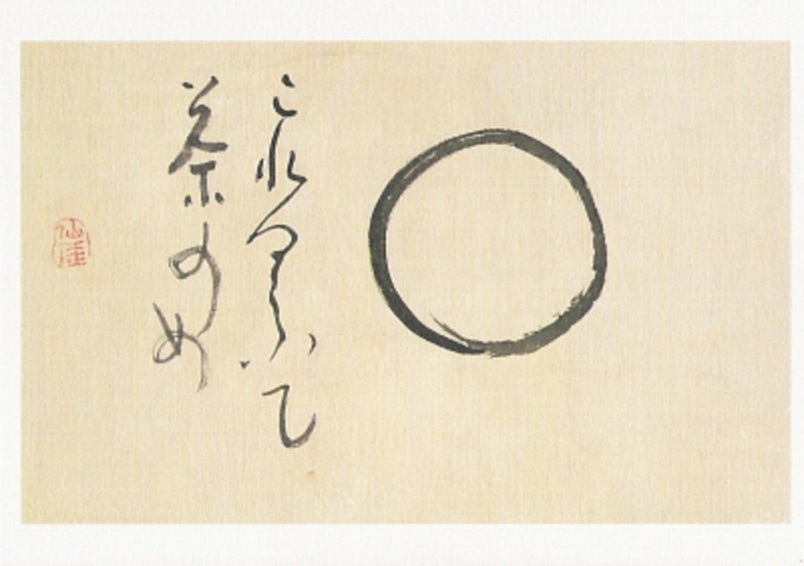
The perspective I have argued for situates art in it’s highest possibility of expression. It is not simply the representation or imitation of the world that is stake, or even the self-expression of non-objective inner states, but a reflection of the world’s ontological unveiling. This would explain why certain traditions such as Japanese Zen-Buddhism have given such great emphasis to artistic practices as central to the process of enlightenment. They are not merely supportive, secondary aids meant to quell unwanted thoughts, focus the mind or maintain awareness stable during worldly activities, but if properly experienced, constitute the very expression of enlightened consciousness itself, a transparent movement from the Mind’s clear apprehension of the world it itself spontaneously generated. Once more, what would it be like for the basic self-centeredness that colors all our perceptions, what Indian sage Ramana Maharshi termed the first thought, to disappear and the Mind fathom itself by itself?
Artistic productions that emerge from such unitary or non-dual states are responses to this question. A canonical case from the Japanese Zen-Buddhist tradition is the figure known as the Ensō, the direct expression of emptiness, the state of no-mind (mu). The Ensō (circle or circular form in Japanese) is a Zen-Buddhist symbol that represents the state known as satori - the realization of emptiness and the attainment of one’s fundamental nature. It serves both a devotional symbol aimed at inducing the recognition of one’s true state of being, and as a creative result that emerges from such a state. Traditionally, the attainment of satori was accompanied by the creation of an Ensō image, and many masters famously left behind their own respective images associated with their realizations19. As Helmut Brinker writes: “Eugen Herrigel regards Zen painting as the end-product of satori, ‘the way in which it expresses itself pictorially .... For there is a distinct school of Zen painting: works in which the illuminated vision of existence is the theme of the picture.”20
Graphically, the Ensō is a relatively simple image, usually created with a single brushstroke. It needs to be traced from a state of “no-mind” (mu in Japanese) - a contemplative condition in which the usual flow of thoughts and self-referential preoccupations are stilled, allowing the background of awareness to emerge unimpeded. In this regard, the Ensō naturally emphasizes negative space, as the state of mind it aims to materialize is one in which the emptiness of pure space is central. In this vein, it is an image where the surrounding space is as important as the trace itself.
Roughly, the Ensō represents the circle, in either its open or closed forms. The circle has a long historical presence within Chinese Buddhism:
The circle (Chinese: yiian-hsiang/yuanxiang; Japanese: enso) has long been a central component in the ideology of Zen Buddhism. We find the third Chinese patriarch Chien-chih Seng-ts’an (Jianzhi Sengcan, died in 606), speaking in his Hsin-hsin-ming (Xinxinming, Japanese: Shinjinmei), the ‘Engraving of Belief in Mind’, of the ‘Circle, which is equivalent to the “Great Emptiness”; nothing is missing, nothing is superfluous!’ The circle as ‘perfect manifestation’, as a form without beginning and without end, represents the annulment of all contradictions to absolute unity and, accordingly, to ‘true emptiness’ (Chinese: cben-k’ung/zhenkong; Japanese: sbinku). It symbolises the formless and colourless Being-as-it-is of all things in creation, the ‘original lineaments before birth’, of which it is said in the Wu-men-kuan (Wumenguan; Japanese: Mumonkan): ‘Even when we paint it, it is not painted.21
Nonetheless, the Ensō is characteristically asymmetrical, evincing a notable quality of imperfection. This is not unintentional. Nature is not bound by abstract standards of perfection. It creates without concern for our aesthetic categories. Zen seeks an unification with the spirit of nature’s creativity, both in its manifest and unmanifest dimensions. For Zen, nature is the true standard by which we measure the beauty of any creation. This is the reason for the natural roughness of the Ensō. Its crudeness expresses its authenticity. There is no artifice, no intentional design, no control, no ego. It is primarily the result of an spontaneous unselfconscious creation. If one is able to live in this way, in all situations of life, then who is living? Is there a remaining distinction between oneself and whatever takes place? When the subject is no more, what indeed is left of the object? It is the intuitive realization of these questions that Zen art embodies, and particularly the Ensō.
It is certainly significant that the Ensō appears prominently in Zen, a tradition known for its lack of conventional images of veneration and cult. In fact, while Zen practices highly emphasize the ordinary activities of life, and ritualize them, such as the chanoyu tea ceremony, the practice of ikebana (flower arrangements) or sumi-e painting, there is a marked absence of symbols that direct consciousness towards its ultimate source, such as the Ensō. Zen tries implicitly to blur the distinction between the sacred and the profane orders of reality, and through its contemplative transformation of the profane, aims to fuse them into a single experiential whole. In contrast, in some Buddhist schools such as the Vajrayana Tradition that developed in Tibet, matters are quite different, and a highly complex iconography and imaginal unfoldment took place22. So this is not a question of Buddhist philosophy in itself not being amenable to imagistic approaches and wide-ranging visual representation; rather, Zen constitutes a particular flavor and emphasis of the main Mahayana doctrine of emptiness (sunyata) and its posterior development first in Chinese soil and later in Japan.
The metaphysical significance of the Ensō can be more properly illustrated within the sequence of images known as the Ten Ox-Herding pictures. These images, known to have emerged in 12th century China, portray the journey of the soul towards enlightenment. In this particular sequence, the ox symbolizes the original nature, the buddha nature, which is initially hidden and unavailable to the seeker. In this set of images the Ensō appears at the 8th stage, in which the monk or the seeker after enlightenment finally realizes his own fundamental nature. In the subsequent image, the world emerges within the Ensō, emptiness itself, signifying that now reality has been seen thoroughly and has been established on a new basis.
The Ensō emphasizes that this new basis is one that possesses no inherent characteristics. There is nothing to see or grasp, nothing that can be held by the imagination or the senses. It is as if the image is indicating that the container is as important as the contained – and possibly more so. That which holds the experience of the world together is never directly seen and yet, without it, nothing could ever exist. How to attain or realize such an intangible and elusory understanding? If phenomena emerge within a reality which is essentially insubstantial, empty of essential forms, no proper representation of it can be made. It is an apophatic mode of cognition par excellence. This explains why Zen was always so wary of metaphysics and so reluctant to formalize its doctrines; they go directly against the very underlying intent of the teachings, of what they attempt to produce in the inner life of its practitioners.
Zen masters have historically preferred to transmit their understanding non-verbally or through the formulation of paradoxes, in order to break down the strictures of the rational mind. In a famous passage attributed to Bodhidharma, the legendary 6th century Indian monk that was the first patriarch of Zen (Chinese Ch ‘an) – and by critics to the later monk Nansen (748-834 c.e.) – the essential principles of Zen are concisely stated: “A special transmission outside scriptures (kyoge betsuden); No dependence upon words and letters (furyu monji); Directly pointing at the mind of man (jikishi ninshin); Seeing into his own nature, man attains Buddhahood (kensho jobutsu).”23
It is this direct pointing towards ultimate reality beyond conceptualizations that defines the essential spirit of Zen practice in general. There is no positive knowledge that actually needs to be learned or acquired, but rather a radical relinquishment of an erroneous sense of being that clouds the mind’s understanding of itself. It is an unusual soteriology, one that promises no final fusion with a higher being or the elevation towards heavenly realms or states. It posits that a misunderstanding has taken place within consciousness, an existential error that once dissolved will reveal reality as it is and as it has never stopped being. And not a reality that occupies a transcendent position in relation to this world, but crucially, a reality which is this world properly seen.
What is it that we do not actually see about our very own life? Is our life actually ours, at all? This is a fundamentally Zen question. Who lives? Who sees? In what way does the self constitute the essential block that needs to give away for reality to reveal itself as it is? It is through this pointing of a meaningful absence, one that allows a novel kind of seeing, that we are able to understand why the absence that is salient in the Ensō is so significant. It underscores the emptiness of our very own being or self. It is not dissimilar in its effect from Robert Rauschenberg’s 1951 White Paintings or Mark Rothko’s purely black paintings in the Rothko Chapel. In both of these works, an homogeneous canvas attempts to convey a kind of present absence which gives no pictorial references to the viewer. There is nothing to see. At least, nothing in the usual sense. The viewer is transported back to herself, to the very act of contemplation itself. The image operates then as a mirror, a way of reflecting a subjective inner core that might be more properly approached through pure blackness, whiteness or a simple brushstroke that reveals an otherwise plain canvas. When objectivity is no more, than nothing but pure subjectivity is left. Consciousness may become self-reflective in a deeper, more pronounced way. Perception itself is brought into the foreground of consciousness, and as it becomes transformed, so does the object, the material cosmos otherwise inadequately viewed.
Consequently, the aesthetical pedagogy of the Ensō is non-ideational. One is not supposed to think about it, to construct a philosophy around it, to discuss it in the usual way or to associate freely. If there is anything that it conveys, it would be the state of mind in which no other representations are warranted. That this condition is associated with ultimate sacredness, is something rather foreign to objective western cognition. An ontological denuding needs to occur before a direct intuitive realization of its significance can take place. This is not unlike the Christian kenosis, the emptying of self-centeredness that must precede union with God. In both, the hidden was the source of meaning all along, yet ignored and unseen. As in the vision of Pseudo-Dionysius24, Zen is seeking to convey the fundamental meaningfulness of the uncreated, of reality without any kind of projections or attributions. It tries to show how the unmanifest is fundamentally responsible for the significance of the manifest world itself, our ordinary reality. How only stepping out of the created, can its true meaning show itself.
In the act of creation, it also seeks to answer the problem of how the subject can let the whole of process of reality manifest without obstructions. This is not foreign to the creation of art in general. Many artists have described their moments of heightened consciousness as being states in which they are no longer in control25. The painting, the sculpture or the poem happens by itself, spontaneously. This brings forth a clear association with the Taoist conception of wu-wei, non-volitional action. Activity devoid of self-involvement is seen to express a beauty that is otherwise inaccessible. If one is able to disappear during creation, then who creates? What creates? Do we become vessels in those moments for a different kind of energy, liable to influences from deeper sources beyond the self’s boundaries?
This is significant for our understanding of the reasons for the sacredness of the Ensō that lie beyond its symbolic significations. It is not actually painted by oneself, but truly, by emptiness. It is a pure expression of non-intentional creativity, which possesses a life of itself beyond any attempt to control it or mold it. That is why the Ensō is never improved, never edited or embellished. Once the brushstroke is made, it is done, finished. No-thingness has spoken. It reveals the completeness of every single moment. As in haiku poetry, it is in the enlightened instant of perception that the meaning of things reveals itself – of any perception. What Blake saw is also what the Zen practitioner sees in the moment of satori. A moment of clear vision, subject and object dropped and an infinite significance emerging from every single phenomena.
Conclusion
I have explored in this essay questions regarding modified ontological states, which I have termed ontological shifts, and their corresponding expressions in the world, through the medium of visionary art. My intent was to bridge accounts in the contemporary consciousness with those present in the literature of mysticism, focusing here on a selection of mystical writers and artists and, within Buddhism, in Dzogchen and Zen-Buddhism. Starting with Istvan Banyai’s Zoom series, I wanted to show how a radical shift in awareness, a direct seeing of one’s fundamental nature, can be lived through as moment or process of artistic creation in which the division between oneself and the world drops. I emphasized how enlightened seeing might unveil the actual unacknowledged unitary character of the world, and how art, focusing on the specific case of the Ensō, might function as the vessel for this novel kind of ontology.
This approach attempted to straddle two goals: to initiate a discussion on states of awakening that are lived outside of the traditions, within a contemporary context – the ontological shifts – and the ways in artistic practice might serve as the basic grounding for such states. The viewpoint of this essay if frankly transreligious, or to employ a term that has acquired a rather negative connotation in modern academic discussions, neo-perennial. I believe that an emic understanding of Zen or Dzogchen or of romantic artists such as Blake or Franck unveils a state of mind or awareness that transcends local and historical determinations. It might be possible to argue etically, from outside, and say that their statements can only be appraised from within their particular contexts. This is certainly possible, but goes against – in my opinion – the very claims they espouse. If the major claim that awareness, consciousness or the buddha-nature is transversal concerning all contexts is true, it must be so. In this sense, I would argue that a purely agnostic and scientific investigation of consciousness in the modern vein would lead towards something very similar to what has been stated by these authors and traditions. They are clearly not saying the same thing, but their common emphasis on non-conceptuality and going beyond representation is certainly the major point here.
The importance of art and of the non-verbal humanities is, to my mind, central for this kind of exploration. Language has a tendency to produce states of mind in which these differences are exclusively recognized but their underlying silent referent is not. I think that artistic cognition, in which objects and the subjective world is apprehended purely intuitively, without the filtering activity of conceptuality, could be an important antidote to the bias of the Western rational mind that ignores and excludes the epistemic and ontological validity of these states. They are discussed, but never with their own meaning and implications acquiring the foreground of consciousness. They are touched and dissected at a distance, in contrast with the multiplicity of additional interpretations that are simply, and dogmatically, understood as interpretations only. I think that a sociology of knowledge that proceeds in this manner is essentially self-defeating. We can study Plotinus, but only as a an exemplar of a particular historical school of thought, a Neoplatonic type – never for what he actually says. We can see the Ensō, but never acknowledge its inner meaning, what it brings forth in its experiential or contemplative dimensions – only in contrast with the corpus of congealed meanings of scholarship. This leaves the central meaning of our objects of study in brackets, and, unless the scholar is willing to leave this epistemic straightjacket, no possible understanding of what we are actually studying will emerge, but only a shadow, a pale and dim reflection, that however glorified, will never cease to be that: a reflection, a schema. Are we capable of dropping such intellectual schemas in order to actually see through them? Is enlightened academic seeing, possible, at all?