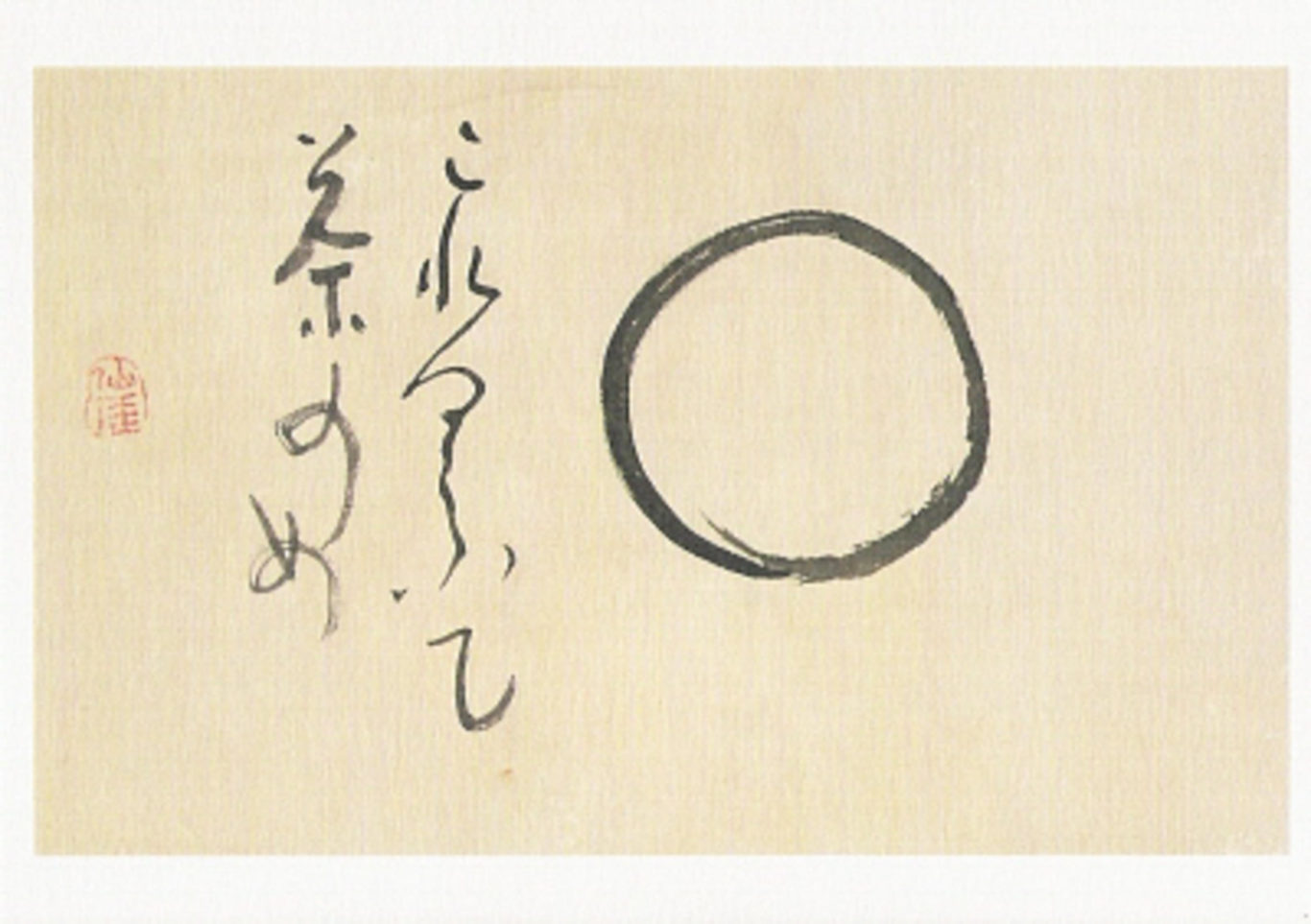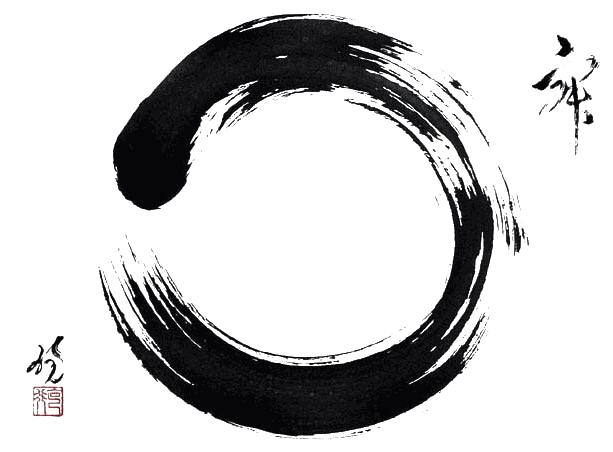
The Ensō (circle or circular form in japanese) is a Zen-Buddhist symbol that represents the state known as satori - the realization of emptiness and the attainment of one’s fundamental nature. It serves both a devotional symbol aimed at inducing the recognition of one’s true state of being, and as a creative result that emerges from such a state. Traditionally, the attainment of satori was accompied by the creation of an Ensō image, and many masters famously left behind their own respective images associated with their realizations1. As Helmut Brinker writes:
“Eugen Herrigel regards Zen painting as the end-product of satori, ‘the way in which it expresses itself pictorially .... For there is a distinct school of Zen painting: works in which the illuminated vision of existence is the theme of the picture.”2
Graphically, the Ensō is a relatively simple image, usually created with a single brushstroke. It needs to be traced from a state of “no-mind” (mu in japanese) - a contemplative condition in which the usual flow of thoughts and self-referential preoccupations are stilled, allowing the background of awareness to emerge unimpeded. In this regard, the Ensō naturally emphasizes negative space, as the state of mind it aims to materialize is one in which the emptiness of pure space is central. In this vein, it is an image where the surrounding space is as important as the trace itself.
Roughly, the Ensō represents the circle, in either its open or closed forms. The circle has a long historical presence within chinese buddhism:
“The circle (Chinese: yiian-hsiang/yuanxiang; Japanese: enso) has long been a central component in the ideology of Zen Buddhism. We find the third Chinese patriarch Chien-chih Seng-ts’an (Jianzhi Sengcan, died in 606), speaking in his Hsin-hsin-ming (Xinxinming, Japanese: Shinjinmei), the ‘Engraving of Belief in Mind’, of the ‘Circle, which is equivalent to the “Great Emptiness”; nothing is missing, nothing is superfluous!’ The circle as ‘perfect manifestation’, as a form without beginning and without end, represents the annulment of all contradictions to absolute unity and, accordingly, to ‘true emptiness’ (Chinese: cben-k’ung/zhenkong; Japanese: sbinku). It symbolises the formless and colourless Being-as-it-is of all things in creation, the ‘original lineaments before birth’, of which it is said in the Wu-men-kuan (Wumenguan; Japanese: Mumonkan): ‘Even when we paint it, it is not painted.’3
Nonetheless, the Ensō is characteristically asymmetrical, evincing a notable quality of imperfection. This is not unintentional. Nature is not bound by abstract standards of perfection. It creates without concern for our aesthetic categories. Zen seeks an unification with the spirit of nature’s creativity, both in its manifest and unmanifest dimensions. For Zen, nature is the true standard by which we measure the beauty of any creation. This is the reason for the natural roughness of the Ensō. Its crudeness expresses its authenticity. There is no artifice, no intentional design, no control, no ego. It is primarily the result of an spontaneous unselfconscious creation. If one is able to live in this way, in all situations of life, then who is living? Is there a remaining distintion between oneself and whatever takes place? When the subject is no more, what indeed if left of the object? It is the intuitive realization of these questions that Zen art embodies, and particularly the Ensō.
It is certainly significant that the Ensō appears prominently in Zen, a tradition known for its lack of conventional images of veneration and cult. In fact, while Zen practices highly emphasize the ordinary activities of life, and ritualize them, such as the chanoyu tea cerimony, the practice of ikebana (flower arrangements) or sumi-e painting, there is a marked absence of symbols that direct consciousness towards its ultimate source, such as the Ensō. Zen tries implicitly to blur the distinction between the sacred and the profane orders of reality, and through its contemplative transformation of the profane, aims to fuse them into a single experiential whole. In contrast, in some Buddhist schools such as the Vajrayana Tradition that developed in Tibet, matters are quite different, and a highly complex iconography and imaginal unfoldment took place4. So this is not a question of Buddhist philosophy in itself not being amenable to imagetic approaches and wide-ranging visual representation; rather, Zen constitutes a particular flavor and emphasis of the main Mahayana doctrine of emptiness (sunyata) and its posterior development first in chinese soil and later in Japan.
The metaphysical significance of the Ensō can be more properly illustrated within the sequence of images known as the Ten Ox-Herding pictures. These images, known to have emerged in 12th century China, portray the journey of the soul towards enlightenment. In this particular sequence, the ox symbolizes the original nature, the buddha nature, which is initially hidden and unavaliable to the seeker. In this set of images the Ensō appears at the 8th stage, in which the monk or the seeker after enlightenment finally realizes his own fundamental nature. In the subsequent image, the world emerges within the Ensō, emptiness itself, signifying that now reality has been seen throughly and has been established on a new basis.
The Ensō emphasizes that this new basis is one that possesses no inherent characteristics. There is nothing to see or grasp, nothing that can be held by the imagination or the senses. It is as if the image is indicating that the container is as important as the contained – and possibly more so. That which holds the experience of the world together is never directly seen and yet, without it, nothing could ever exist. How to attain or realize such an intangible and elusory understanding? If phenomena emerge within a reality which is essentially insubstantial, empty of essential forms, no proper representation of it can be made. It is an apophatic mode of cognition par excellence. This explains why Zen was always so wary of metaphysics and so reluctant to formalize its doctrines; they go directly against the very underlying intent of the teachings, of what they attempt to produce in the inner life of its practitioners.
Zen masters have historically preferred to transmit their understanding non-verbally or through the formulation of paradoxes, in order to break down the strictures of the rational mind. In a famous passage attributed to Bodhidharma, the legendary 6th century indian monk that was the first patriarch of zen (chinese ch’an) – and by critics to the later monk Nansen (748-834 c.e.) – the essential principles of zen are concisely stated:
“A special transmission outside scriptures (kyoge betsuden); No dependence upon words and letters (furyu monji); Directly pointing at the mind of man (jikishi ninshin); Seeing into his own nature, man attains Buddhahood (kensho jobutsu).”5
It is this direct pointing towards ultimate reality beyond conceptualizations that defines the essential spirit of Zen practice in general. There is no positive knowledge that actually needs to be learned or acquired, but rather a radical relinquishment of an erroneous sense of being that clouds the mind’s understanding of itself. It is an unusual soteriology, one that promises no final fusion with a higher being or the elevation towards heavenly realms or states. It posits that a misunderstanding has taken place within consciousness, an existential error that once dissolved will reveal reality as it is and as it has never stopped being. And not a reality that occupies a transcendent position in relation to this world, but crucially, a reality which is this world properly seen.
What is it that we do not actually see about our very own life? Is our life actually ours, at all? This is a fundamentally Zen question. Who lives? Who sees? In what way does the self constitute the essential block that needs to give away for reality to reveal itself as it is? It is through this pointing of a meaningful absence, one that allows a novel kind of seeing, that we are able to understand why the absence that is salient in the Ensō is so significant. It underscores the emptiness of our very own being or self. It is not dissimilar in its effect from Robert Rauschenberg’s 1951 White Paintings or Mark Rothko’s purely black paintings in the Rothko Chapel. In both of these works, an homogeneous canvas attempts to convey a kind of present absence which gives no pictorial references to the viewer. There is nothing to see. At least, nothing in the usual sense. The viewer is transported back to herself, to the very act of contemplation itself. The image operates then as a mirror, a way of reflecting a subjective inner core that might be more properly approached through pure blackness, whiteness or a simple brushstroke that reveals an otherwise plain canvas. When objectivity is no more, than nothing but pure subjectivity is left. Consciousness may become self-reflective in a deeper, more pronounced way. Perception itself is brought into the foreground of consciousness, and as it becomes transformed, so does the object, the material cosmos otherwise inadequately viewed.
Consequently, the aesthetical pedagogy of the Ensō is non-ideational. One is not supposed to think about it, to construct a philosophy around it, to discuss it in the usual way or to associate freely. If there is anything that it conveys, it would be the state of mind in which no other representations are warranted. That this condition is associated with ultimate sacredness, is something rather foreign to objective western cognition. An ontological denuding needs to occur before a direct intuitive realization of its significance can take place. This is not unlike the Christian kenosis, the emptying of self-centeredness that must precede union with God. In both, the hidden was the source of meaning all along, yet ignored and unseen. As in the vision of Pseudo-Dionysius6, Zen is seeking to convey the fundamental meaningfulness of the uncreated, of reality without any kind of projections or attributions. It tries to show how the unmanifest is fundamentally responsible for the significance of the manifest world itself, our ordinary reality. How only stepping out of the created, can its true meaning show itself.
In the act of creation, it also seeks to answer the problem of how the subject can let the whole of process of reality manifest without obstructions. This is not foreign to the creation of art in general. Many artists have described their moments of heightened consciousness as being states in which they are no longer in control7. The painting, the sculpure or the poem happens by itself, spontaneously. This brings forth a clear association with the Taoist conception of wu-wei, non-volitional action. Activity devoid of self-involvement is seen to express a beauty that is otherwise inaccessible. If one is able to disappear during creation, then who creates? What creates? Do we become vessels in those moments for a different kind of energy, liable to influences from deeper sources beyond the self’s boundaries?
This is significant for our understanding of the reasons for the sacredness of the Ensō that lie beyond its symbolic significations. It is not actually painted by oneself, but truly, by emptiness. It is a pure expression of non-intentional creativity, which possesses a life of itself beyond any attempt to control it or mould it. That is why the Ensō is never improved, never edited or embelished. Once the brushstroke is made, it is done, finished. No-thingness has spoken. It reveals the completeness of every single moment. As in haiku poetry, it is in the enlightened instant of perception that the meaning of things reveals itself – of any perception. What Blake saw is also what the Zen practioner sees in the moment of satori. A moment of clear vision, subject and object dropped and an infinite significance emerging from every single phenomena.